Your jeans fit at the waist. At the thigh? Not even close. You've cut carbs, clocked thousands of steps, maybe tried every diet with a name, and the top half of you shrinks while your legs barely budge. Sound familiar?
That gap, for many women, actually has a name. Lipedema (Lipoedema) is a chronic disorder of fat tissue, and it gets brushed off as "just fat legs" far more often than it should. This guide walks you through the real differences: the ones you can see, the ones you can feel, and the ones that only show up when you try to lose weight.
Why Lipedema Is So Often Mistaken for Fat Legs
Because at first glance it looks exactly like weight gain.
No rash. No redness. Nothing on a routine blood test. A woman walks into a clinic with heavy legs, the scale shows a few extra kilos, and the conversation ends with "eat less, move more". Simple advice; wrong diagnosis.
And it isn't only patients who miss it. Lipedema is still widely underdiagnosed around the world, despite how common it is and how hard it hits quality of life; awareness, even among health professionals, is only now catching up. Hearing the word is one thing. Recognising it in the mirror (or in a busy clinic) is another. That's exactly why an assessment by an experienced cardiovascular surgeon who knows what to look for makes such a difference.
What Makes Lipedema Fat Different from Regular Fat?
This is the heart of it. Everything else in this article grows out of this one point.
Regular fat is storage. Your body tucks away spare energy and, when you burn more than you eat, pulls it back out again. It's soft, it doesn't hurt, and it spreads itself around roughly the way your genes and hormones dictate.
Lipedema fat plays by different rules. The 2021 US consensus guideline on lipedema care describes it as nodular, fibrotic fat tissue that builds up on the buttocks, hips and limbs. Put simply, the tissue itself is abnormal: it tends to be tender, it often feels lumpy under the skin, and over the years it can turn firmer as fibrosis (think scar-like strands woven through the fat) takes hold.
So it's not just more fat. It's a different kind of fat — which is exactly why it ignores the rules ordinary fat follows.
Signs You Can See in the Mirror
Grab a full-length mirror. Three things deserve a closer look.
Symmetry in Both Legs
Lipedema is a mirror image of itself: both legs, same shape, same size. If one leg is clearly bigger than the other, that points elsewhere (often a lymphatic or venous problem) and needs its own assessment.
Slim Feet and the Ankle "Cuff"
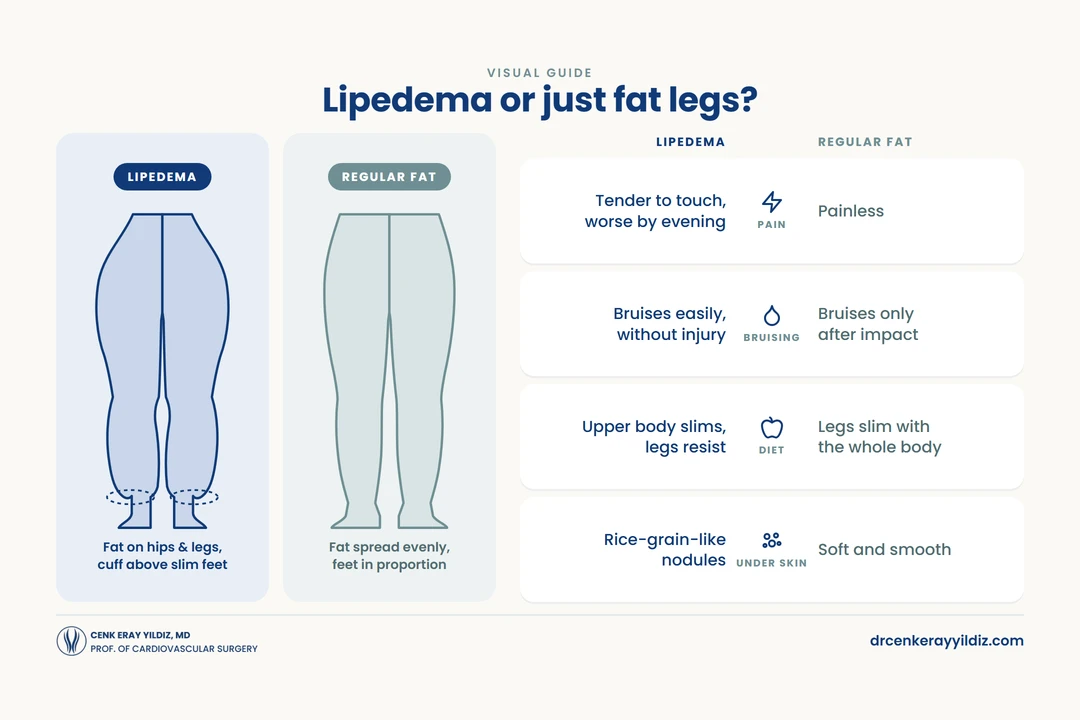
This one's the giveaway. In lipedema the fat stops abruptly just above the ankle, while the foot underneath stays slim — almost as if it belongs to someone else. Doctors call it the "cuff sign". Some women say it looks like wearing invisible, baggy trousers over a perfectly normal pair of feet.
With ordinary weight gain, the taper is gradual. Ankles thicken along with the calves; feet keep pace with the rest of the body. No sharp line, no ledge.
One caveat, though. In advanced lipedema, swelling can eventually creep onto the feet as well. A slim foot supports the diagnosis — a fuller one doesn't rule it out.
A Slim Waist with Disproportionate Legs
A narrow waist, slim arms in many cases, and hips and legs that seem to belong to someone a few dress sizes bigger. Plenty of women end up buying tops and bottoms in completely different sizes. Regular fat is usually fairer about where it settles.
Signs You Can Feel
Pain and Tenderness
Press gently on your thigh. With regular fat you feel pressure, and that's it. With lipedema, the same light touch can actually hurt. Many women describe a dull ache that builds through the day and peaks by evening, along with a heavy, tired feeling in the legs that a good night's sleep doesn't quite shift.
Easy Bruising
Bruises that turn up out of nowhere. You can't remember bumping into anything — there they are anyway. Fragile small blood vessels within lipedema tissue are thought to be the culprit.
Nodules Under the Skin
Run your fingertips slowly over your inner thigh or just above the knee. Lipedema tissue often hides small lumps beneath the surface; women compare them to grains of rice, to peas, and in later stages even to walnuts. Normal fat feels smooth and even.
Cool Skin
A small sign but a real one: the skin over affected areas often feels cooler than the rest of your body.
Why Won't My Legs Lose Fat? Lipedema and Diet
Probably the most frustrating part of the whole thing.
With regular fat, a calorie deficit works across the board. You lose a little from the face, the belly, the arms, the legs. Slowly, unevenly maybe, but everywhere.
Lipedema doesn't play along. Women stick to strict diets and see the upper body get slimmer, while the hips and legs simply refuse to shift. Sometimes the disproportion even looks worse after weight loss, simply because the top half shrank and the bottom half didn't.
One published case report makes the point bluntly. A woman with stage 3 lipedema had gastric bypass surgery and lost a substantial amount of weight; her trunk got significantly smaller. Her legs didn't.
Does that make healthy eating pointless? Not at all — and this is where we'd push back on a lot of what you'll read online. A sensible diet keeps extra regular fat off, calms inflammation and takes load off your joints, and researchers are paying growing attention to anti-inflammatory and lower-carbohydrate eating for lipedema symptoms. It just won't melt lipedema fat the way it melts ordinary fat. Knowing that difference saves a lot of guilt.
When Does Lipedema Start?
Timing tells a story.
Puberty, Pregnancy and Menopause
Lipedema tends to appear (or step up a gear) at times of hormonal change, and these three are the big ones. Many women trace it back to their teenage years, when their legs suddenly grew out of step with the rest of their body. Others notice a jump after a pregnancy or around menopause. Ordinary weight gain rarely follows a hormonal calendar like that; it follows lifestyle, age and, frankly, life getting busy.
Family History
Look at your mother, your aunts, your grandmother. Lipedema often runs in families, so if the women around you share that same heavy-legs, slim-feet shape, take note.
Can You Have Both Lipedema and Excess Weight?
Yes. And this is exactly where most online checklists fall apart.
Lipedema and obesity aren't an either/or choice. Plenty of women have both, and the 2021 US guideline lists non-lipedema obesity among the conditions that commonly sit alongside it. That overlap makes self-diagnosis tricky, because extra regular fat can blur the very signs you'd otherwise spot.
So how do you tell them apart when one sits on top of the other? Look past size. Focus on the features that excess weight alone doesn't cause:
- pain or tenderness in the leg fat
- bruising without a clear reason
- a distinct cuff above slim ankles
- disproportion that stays put, or gets worse, after weight loss
If several of those fit, weight may be part of your picture — but probably not the whole of it. Untangling the two is a job for a clinical examination, not a mirror.
Lipedema vs Regular Fat: Side-by-Side Comparison
Short on time? Here's the whole article at a glance (the infographic at the top of the page sums it up visually, too).
| Feature | Lipedema | Regular fat |
|---|---|---|
| Pain | Tender to touch, worse by evening | Painless |
| Bruising | Bruises easily, without injury | Bruises only after impact |
| Fat distribution | Hips, thighs and calves | Spread evenly across the body |
| Symmetry | Identical in both legs | No distinct symmetry |
| Feet & ankles | Feet spared, "cuff" above the ankle | Feet in proportion to the body |
| Under the skin | Rice-grain-like nodules | Soft and smooth |
| Response to diet | Upper body slims, legs resist | Legs slim along with the rest of the body |
When to See a Lipedema Specialist in Istanbul
Ticked more than a couple of boxes in that table? Then it's worth getting checked properly.
Lipedema is a clinical diagnosis. There's no single blood test or scan that confirms it, so it comes down to an experienced specialist examining your legs, hearing your story and ruling out the conditions that mimic it, such as lymphedema and venous disease. As a cardiovascular surgeon, Prof. Dr. Cenk Eray Yıldız assesses lipedema together with the vein and lymphatic problems that often travel with it. Our lipedema treatment page explains how that evaluation works and what comes next.
Travelling from abroad? You can share your reports and symptoms with the clinic team before you fly, so your first appointment in Istanbul really counts.